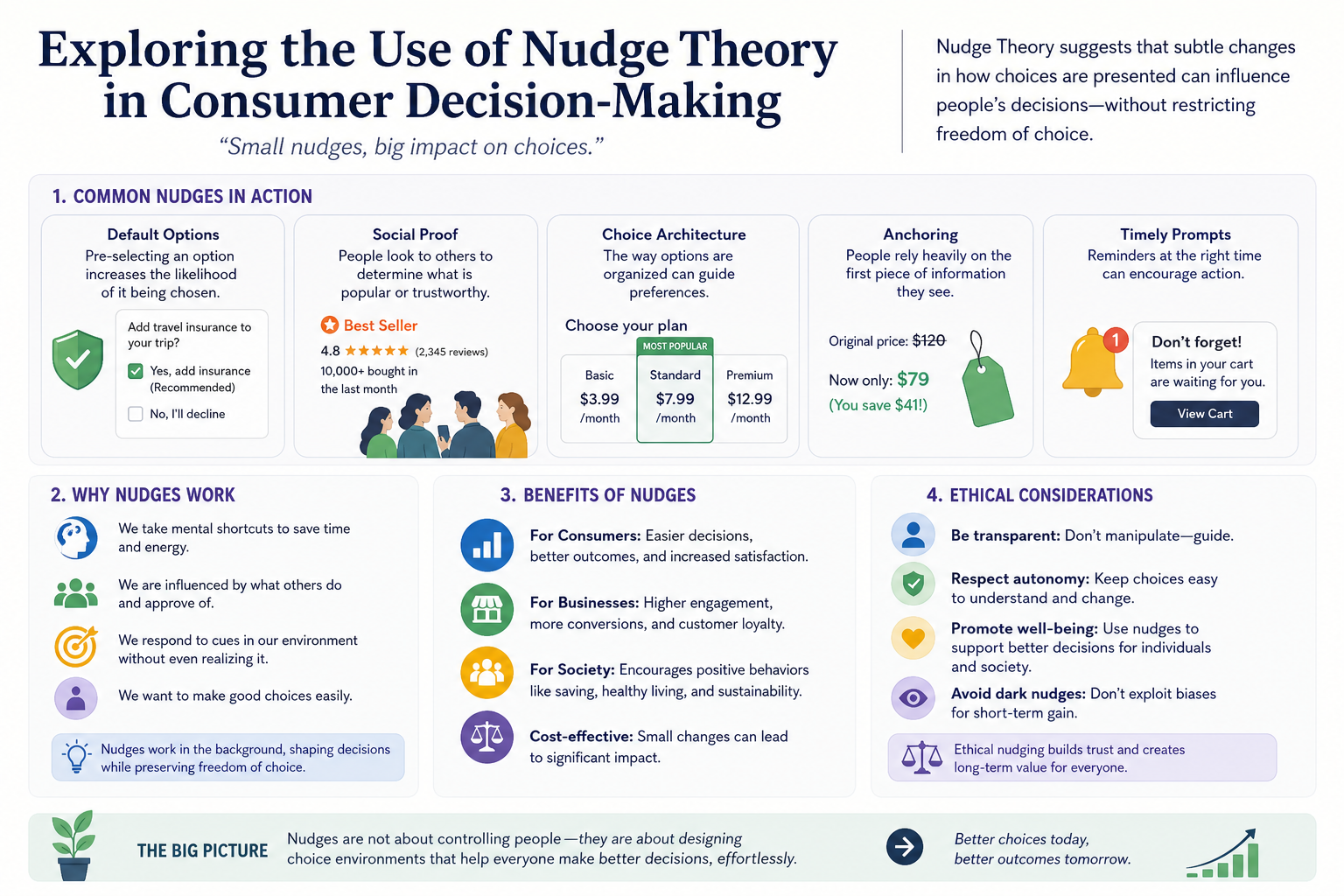
Nudge theory is becoming one of the most important tools for shaping the future of consumer decision-making. At its core, it focuses on subtle changes in how choices are presented so that people are more likely to make decisions that benefit themselves and society. Unlike coercion or heavy-handed regulation, nudges work by aligning with human behavior, making better choices easier, clearer, and more intuitive. In the future, this approach will likely become more sophisticated, more personalized, and more deeply embedded in everyday consumer experiences.
As digital platforms continue to evolve, nudge theory will increasingly be powered by data, artificial intelligence, and behavioral science. Online retailers, financial services, healthcare platforms, and subscription businesses are already testing how timing, framing, defaults, and visual design influence decisions. In the coming years, consumers will encounter systems that can anticipate hesitation, reduce overload, and guide them toward options that are more affordable, sustainable, or healthier. A well-designed digital environment may help people save more money, waste less food, select better insurance plans, or reduce impulsive purchases without removing freedom of choice.
One of the most promising futures for nudge theory lies in ethical personalization. Instead of treating all consumers the same, businesses will be able to tailor nudges to individual needs, values, and goals. A consumer trying to cut household expenses might be nudged toward lower-cost alternatives at checkout. Someone focused on health might receive clearer food labels and portion prompts. A customer who wants to reduce environmental impact could see carbon comparisons before purchase. This creates the possibility of consumer experiences that are not only more efficient, but more human-centered and supportive of long-term wellbeing.
The future will also bring greater public attention to transparency and trust. As nudges become more powerful, consumers will expect to know when they are being influenced and why. The most successful organizations will be those that use behavioral design openly and responsibly. This means building systems that help people make informed choices rather than exploiting psychological bias for short-term profit. Positive futurism suggests that businesses that respect consumer agency will outperform those that rely on manipulation. Ethical nudging can become a competitive advantage, strengthening loyalty, credibility, and brand resilience.
Nudge theory will also play an important role in solving large-scale social and economic challenges through consumer behavior. Governments, retailers, and technology companies can work together to encourage energy conservation, healthier diets, better savings habits, and lower-emission purchasing patterns. Future supermarkets may redesign shelves to make nutritious foods more visible. E-commerce platforms may default to low-waste shipping options. Financial apps may automatically guide users toward emergency savings habits. These changes may seem small on their own, but at scale they can shift entire markets and improve collective outcomes.
Looking ahead, the future of nudge theory in consumer decision-making is not about controlling people. It is about designing environments that respect human limitations while unlocking human potential. In a world of endless options, rising complexity, and constant digital influence, consumers will increasingly benefit from systems that make good decisions easier to recognize and easier to act on. Used wisely, nudge theory can help create a marketplace that is smarter, fairer, and more aligned with the goals people genuinely care about.